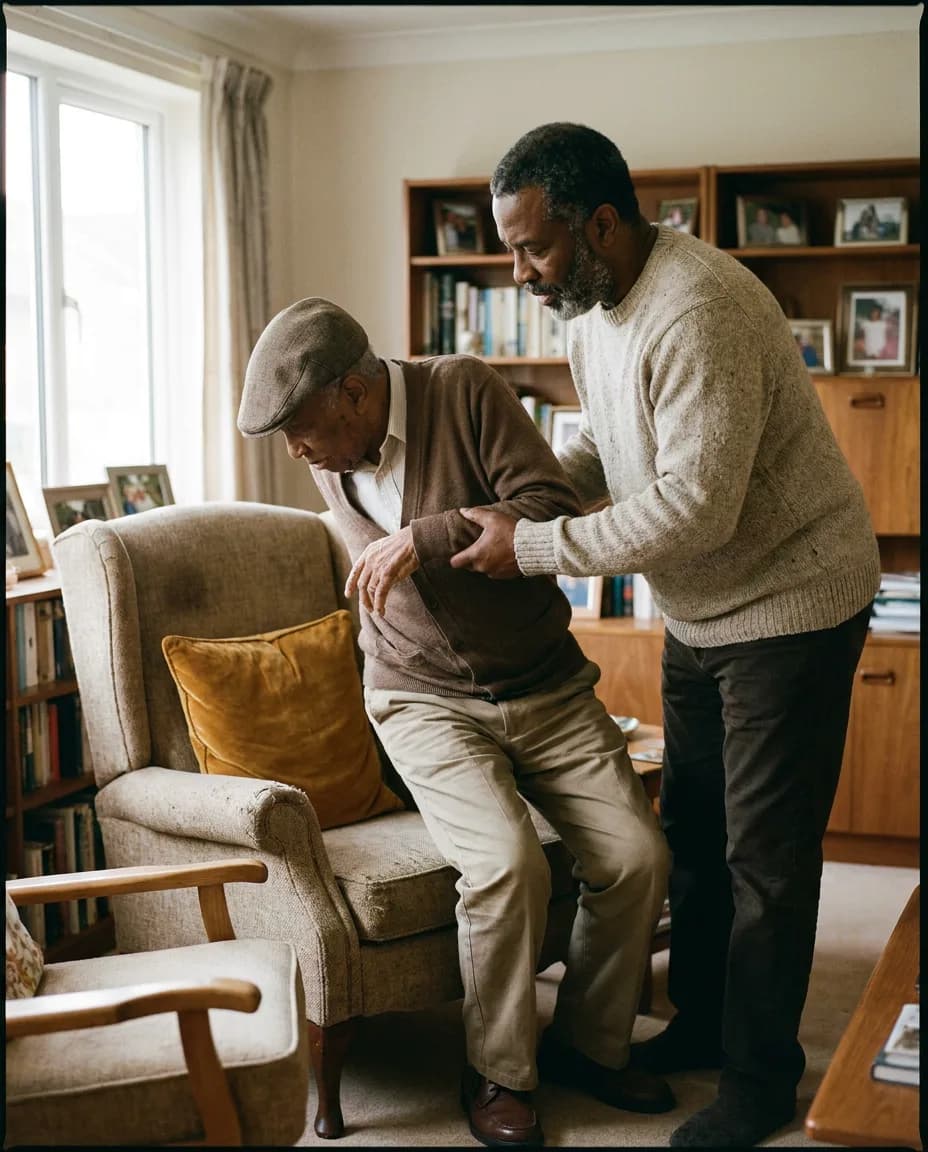
What is senior home care?
Senior home care is practical help for older adults who want to stay in their own house or apartment. For senior care, home care is usually the first step, long before assisted living or a nursing home. For elder care, home care means the help comes to the person instead of the person moving to the help.
It's also called elderly care, elder care, in-home adult care or at-home adult care. Some people search for a "caregiver for old people" or for "care in own home for elderly" relatives. Others type "homecare for elderly at home". They all mean the same thing: care for elderly people where they already live. Care for elderly in their home simply means someone comes in to help.
Senior home care is not the same as home health care. It's non-medical: help with bathing, dressing and meals rather than nursing. Read non-medical home care and home health vs. home care for the difference, or start with our overview, what is in-home care.
Home care services for elderly adults: what's included
Home care services for elderly people cover the tasks that get harder with age. At-home senior care services usually include:
- Personal care — bathing, dressing, grooming, toileting and help moving safely around the house.
- Meals — shopping, cooking and making sure meals actually get eaten.
- Medication reminders — prompts to take medicine at the right time.
- Housekeeping — laundry, dishes, tidying and a safe, clear floor.
- Transport and errands — rides to appointments, the pharmacy and the store.
- Companionship — conversation, walks, hobbies and supervision for someone with memory loss.
These senior home services are also called senior in-home care services, senior home care assistance, home elder care services, senior in-home assistance, at-home assistance for elderly adults, home assistance for elderly adults or home care assistance for elderly relatives. In-home services for elderly people can be one visit a week or care every day. Assistance for elderly living at home — and assistance for the elderly at home more broadly — can also include adult day programs, meal delivery and transport from the local Area Agency on Aging.
Senior care at home services and other at-home care services for elderly clients are usually sold by the hour when you buy from an agency. Home services for the elderly paid by Medicaid are set by an assessment of what the person needs.
Caregivers for seniors: who provides elderly care at home
An elderly caregiver might be an agency aide, an independent aide you hire yourself, or a family member. Each works a little differently.
| Type of caregiver | Who hires them | Good to know |
|---|---|---|
| Agency caregiver | The home care agency | Screened, insured, with backup staff. Higher hourly price. See choosing an agency. |
| Independent caregiver | You or your parent | Lower price, but you're the employer. See private pay home care. |
| Home health aide | A home health or care agency | Extra training; can do more hands-on tasks. See home health aides. |
| Family caregiver | Your parent, through Medicaid | Can be paid in every state. See paid family caregiving. |
In-home caregivers for seniors are sometimes called a carer for elderly adults, a senior care aide, an adult caregiver or an adult caretaker. Caretakers for seniors, senior home caregivers and home caregivers for elderly people do the same work whatever the title — caregivers for elderly at home and caregivers for seniors at home are one job. A caregiver for senior citizens who stays with the same person for months becomes part of the routine, which matters more than any credential.
In Britain, a carer for elderly at home is often called a home help, and home helps for the elderly do much of what an American home care aide does.
Home help for seniors: small amounts of care that go a long way
Not every older adult needs a caregiver all day. Home help for seniors often starts with a few hours: a shower twice a week, groceries, a clean kitchen. Home help for the elderly at this level keeps small problems from turning into falls or hospital stays.
Senior caregiving rarely stays the same size for long, and home care help for seniors can grow as needs grow. Start with the hardest part of the week and add from there. See part-time and short-term home care for hourly options, sitters and minimum shift lengths.
When it's time for at-home care for elderly parents
Families rarely see one clear moment. It builds. These are common signs that at-home care for elderly parents would help:
- Skipped meals, weight loss or spoiled food in the fridge.
- Missed medications or doctor visits.
- Trouble with stairs, bathing or getting out of a chair.
- A fall, even one without injury.
- Unpaid bills, unopened mail or a home that's no longer kept up.
- A family caregiver who can't keep going alone — see respite care.
Getting home care for elderly relatives early, while it's a few hours, is easier than getting care for elderly at home after a hospital discharge. Our guide to caring for aging parents covers the harder conversations.
Find out in 2 minutes
Answer 5 easy questions. See your programs and pay before you share any contact info.
Getting in-home care for elderly relatives: step by step
- Write down the needs. Which tasks, which times of day, how many days a week.
- Check Medicaid first. If your parent may qualify, it changes who pays. Check eligibility in two minutes.
- Call the Area Agency on Aging. It can point to local services for seniors living at home, other services for elderly living at home such as meals and transport, and state programs.
- Choose the caregiver. An agency, an independent caregiver, or you — paid through Medicaid.
- Set a care plan. Tasks, hours, emergency contacts and a backup for missed shifts.
- Review after a month. Adjust before small problems grow.
If you're getting in-home care for elderly parents in another state, the state page is the place to start — for example Florida, Arizona or North Carolina. Help with home care for elderly relatives, like help with senior care at home, is local, so our home care near me guide explains how to find and vet options in your county.
Finding senior care help near you
Assistance for seniors living at home is delivered locally, by agencies licensed in your state and by programs run through your county. Look up the county page for the details — Palm Beach County, Maricopa County, Mecklenburg County, Cuyahoga County or Allegheny County.
When you compare agencies offering caregiver services for seniors, ask how they screen and train aides, whether aides are employees, and what happens if a caregiver calls in sick. Our agency checklist and local home care agencies compared help you judge. You can also compare national franchises, such as Home Instead and Home Helpers.
What senior home care costs
According to CareScout's 2025 Cost of Care Survey, the national median rate for a non-medical in-home caregiver was $35 an hour — $80,080 a year at 44 hours a week. Prices vary widely by state and city.
| Care | Median cost | At that rate |
|---|---|---|
| Non-medical caregiver | $35/hour | 10 hours a week ≈ $350 |
| Non-medical caregiver | $35/hour | 44 hours a week ≈ $80,080 a year |
| Adult day health care | $95/day | 5 days a week ≈ $24,700 a year |
| Assisted living | $6,200/month | $74,400 a year |
| Nursing home, semi-private | $315/day | $114,975 a year |
For most people who need a few hours a day, home care is cheaper than a facility. For round-the-clock care it often isn't — see 24-hour home care and the cost of in-home care.
How to pay for elderly care at home
| Source | Pays for senior home care? | Details |
|---|---|---|
| Medicaid | Yes, in every state | Income, asset and care-need rules. Medicaid home care. |
| Medicare | No ongoing care | Covers short-term skilled home health only. Medicare and caregivers. |
| VA | Yes, for eligible veterans | Support programs. |
| Long-term care insurance | Often | Depends on the policy's home care terms. |
| Private pay | Yes | Private pay home care. |
Medicare.gov is clear that Medicare home health doesn't cover 24-hour care, homemaker services unrelated to a care plan, or personal care when that's the only care needed. For ongoing senior care, Medicaid is the main public payer.
Caregiver services for elderly parents from family — and getting paid
Many families already provide caregiving services for the elderly without pay. Medicaid in every state has a program that can pay a relative instead. Your parent qualifies, chooses you, and the program pays you for the approved hours. It's the same care, but now it's a paid job.
The programs go by different names: CDPAP in New York, IHSS in California, IRIS in Wisconsin and Structured Family Caregiving in several states. Connecticut's Adult Family Living program pays a live-in caregiver a stipend; see Connecticut. Programs like these offer care for adults of any age who qualify, not only seniors.
| State | Programs that can pay a family caregiver | |
|---|---|---|
| Alabama | Personal Choices, E&D Waiver, ACT Waiver, SAIL Waiver | Alabama program → |
| Alaska | Personal Care Services (PCS), Community First Choice (CFC), Children's waivers (CCMC & IDD) | Alaska program → |
| Arizona | ALTCS self-directed care, Agency with Choice, Parents as Paid Caregivers (PPCG) | Arizona program → |
| Arkansas | IndependentChoices, ARChoices in Homecare | Arkansas program → |
| California | IHSS (In-Home Supportive Services) | California program → |
| Colorado | CDASS, IHSS, Family CNA program | Colorado program → |
| Connecticut | Adult Family Living (AFL), Community First Choice (CFC), PCA Waiver, CT Home Care Program (CHCPE) | Connecticut program → |
| Delaware | DSHP-Plus self-directed care | Delaware program → |
| District of Columbia | EPD Waiver — Services My Way | District of Columbia program → |
| Florida | SMMC-LTC Participant Directed Option, CDC+, Family Home Health Aide (children) | Florida program → |
| Georgia | Structured Family Caregiving (SFC), CCSP / SOURCE, NOW & COMP Waivers, GAPP (children) | Georgia program → |
| Hawaii | QUEST Integration self-direction | Hawaii program → |
| Idaho | A&D Waiver self-directed care, Personal Care Services (PCS), Certified Family Home | Idaho program → |
| Illinois | Community Care Program (CCP), Home Services Program (HSP), MFTD Waiver (children) | Illinois program → |
| Indiana | Structured Family Caregiving (SFC), Attendant Care (PathWays & H&W Waivers) | Indiana program → |
| Iowa | Consumer Choices Option (CCO), CDAC (agency-delivered) | Iowa program → |
| Kansas | Frail Elderly Waiver, Physical Disability Waiver, Brain Injury Waiver, Technology Assisted Waiver (children) | Kansas program → |
| Kentucky | Participant Directed Services (PDS), HCB Waiver, Michelle P. Waiver | Kentucky program → |
| Louisiana | Community Choices Waiver, Monitored In-Home Caregiving (MIHC), Children's Choice Waiver | Louisiana program → |
| Maine | Consumer Directed Attendant Services (Section 12), Home & Community Benefits (Section 19), Family Home Health Aide (children, 2026) | Maine program → |
| Maryland | Community First Choice (CFC), CPAS, Community Options Waiver, DDA Waivers (children) | Maryland program → |
| Massachusetts | PCA Program, Adult Foster Care (AFC), Frail Elder Waiver | Massachusetts program → |
| Michigan | Home Help Program, MI Choice Waiver | Michigan program → |
| Minnesota | CFSS, CDCS, Elderly Waiver | Minnesota program → |
| Mississippi | Elderly & Disabled Waiver (agency only), Independent Living Waiver | Mississippi program → |
| Missouri | Consumer Directed Services (CDS), Structured Family Caregiving Waiver | Missouri program → |
| Montana | Big Sky Waiver (self-directed), Community First Choice & PCS | Montana program → |
| Nebraska | Personal Assistance Services (PAS), Aged & Disabled Waiver | Nebraska program → |
| Nevada | Personal Care Services (self-directed), Structured Family Caregiving Waiver | Nevada program → |
| New Hampshire | Choices for Independence (CFI) Waiver, PCAS, In-Home Supports Waiver (children) | New Hampshire program → |
| New Jersey | Personal Preference Program (PPP) | New Jersey program → |
| New Mexico | Turquoise Care Self-Directed Community Benefit, Mi Via Waiver | New Mexico program → |
| New York | CDPAP | New York program → |
| North Carolina | CAP/DA (consumer-directed), Coordinated Caregiving, CAP/C (children) | North Carolina program → |
| North Dakota | HCBS Waiver — Family Personal Care, Qualified Service Provider (QSP), Family Paid Caregiver Pilot (children) | North Dakota program → |
| Ohio | PASSPORT Waiver, Structured Family Caregiving, Next Generation MyCare, Ohio Home Care Waiver | Ohio program → |
| Oklahoma | ADvantage Waiver — CD-PASS | Oklahoma program → |
| Oregon | Independent Choices Program (ICP), Spousal Pay Program, Consumer-Employed Provider program | Oregon program → |
| Pennsylvania | Community HealthChoices (CHC), Services My Way, OBRA Waiver | Pennsylvania program → |
| Rhode Island | Personal Choice Program, Independent Provider Program | Rhode Island program → |
| South Carolina | Community Choices Waiver (self-directed), Medically Complex Children Waiver | South Carolina program → |
| South Dakota | Structured Family Caregiving (HOPE Waiver) | South Dakota program → |
| Tennessee | TennCare CHOICES consumer direction, ECF CHOICES, Katie Beckett (children) | Tennessee program → |
| Texas | Consumer Directed Services (CDS), STAR+PLUS HCBS, CLASS & MDCP Waivers | Texas program → |
| Utah | DSPD Caregiver Compensation, New Choices Waiver, Aging Waiver | Utah program → |
| Vermont | Choices for Care (self-directed), Flexible Choices | Vermont program → |
| Virginia | CCC Plus Waiver consumer direction, LRI option (spouses & parents) | Virginia program → |
| Washington | Community First Choice (CFC), Medicaid Personal Care (MPC), Individual Provider (via CDWA) | Washington program → |
| West Virginia | Aged & Disabled Waiver — Personal Options | West Virginia program → |
| Wisconsin | IRIS, Family Care, Personal Care Services (PCS), CLTS Waiver (children) | Wisconsin program → |
| Wyoming | Community Choices Waiver (participant-directed) | Wyoming program → |
Adult home care services for younger adults
Not everyone who needs help at home is elderly, and elderly services are only part of the picture. In-home adult care services also support adults with disabilities, chronic illness or recovery after surgery. Adult home care services use the same caregivers and often the same Medicaid programs. If you're looking for adult care in-home for a son, daughter or spouse with a disability, see consumer-directed care and spouse caregiver rules.
Making home care for elderly people work over time
Home care for elderly people works best when it's planned, not patched together. A few habits help:
- Keep one written care plan that every caregiver and family member can see.
- Mix sources of help. Paid hours, family, adult day and meal programs together cost less than any one alone.
- Plan for bad days. A backup caregiver and a list of who to call.
- Revisit the hours. Needs change, and Medicaid can reassess.
- Look after the caregiver. Burnout ends more home care arrangements than money does. See respite care.
When the need grows to all day and night, compare 24-hour home care, live-in caregivers and assisted living vs. home care.
Where to go next
Frequently asked questions
What is senior home care?
Senior home care is non-medical help that lets older adults keep living at home, including bathing, dressing, meals, medication reminders, housekeeping, transport and companionship.
How much does senior home care cost?
CareScout's 2025 survey put the national median for a non-medical caregiver at $35 an hour. Costs vary a lot by state and city.
Does Medicare pay for senior home care?
Not for ongoing non-medical care. Medicare covers part-time skilled home health for homebound people, not personal care or homemaker help on its own.
Will Medicaid pay for home care for elderly parents?
Yes, if your parent qualifies on income, assets and care needs. Every state has Medicaid home care, and most let your parent choose a family member as the paid caregiver.
Can I get paid to care for my elderly parent?
In almost every state, yes. Adult children can be paid through Medicaid self-directed programs once the parent qualifies.
How do I know it's time for home care?
Common signs are skipped meals, missed medications, falls, trouble bathing, and a family caregiver who is worn out.
Is home care cheaper than assisted living?
For a few hours a day it usually is. For care around the clock, paid privately, home care can cost more than assisted living.
Sources: CareScout 2025 Cost of Care Survey (press release) · Medicare.gov: home health services · Medicaid.gov: mandatory and optional Medicaid benefits. Program rules and rates change — always confirm with the program. Reviewed September 30, 2026.